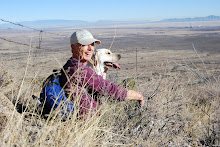
Last month Dan bought me a new set of binoculars, handpicked to be small, light, and easy to take on any hike. I simply love them and have used them daily at the breakfast table (to view the birds, not the breakfast), and have marveled at the beauty of the most ordinary bird.
Yesterday afternoon we made a short excursion to White Water Draw to test out one of Dan's camera lenses and I took the binocs. WWD is an Important Birding Area, well known for the overwintering sand hill cranes that spend the afternoon there after feeding in the agricultural fields in the morning. There are several thousand cranes in one spot, most of them napping, some grooming (there is an amazing amount of bird down flying around there), and some squabble.
The cranes are a marvelous sight by themselves, with their red hats and their beautiful plumage varying from gray to gold. Some birds were even completely gold. In addition there were a number of other water birds that we ordinarily do not see around here and I was able to add many new varieties to my Life List. A lot of these birds only spend the winter here. The binoculars certainly did do their job.
The bird of the day was one that I would never have seen without the binoculars. I just detected movement along the reedy shore and saw a long neck being stretched up and when it was still the bird was completely hidden in the grass. It moved very slowly but once it stepped out into some shallow water, its legs were green! Apple green. It would continue its slow stalk, stretching its neck and being a reed.
At home I found out that this was the American Bittern, a bird I had not heard about and one that is even endangered. Unfortunately we did not hear its unique call, but had it not been for the binoculars, I would have certainly missed him.
February 14, 2013
February 12, 2013
The Wash
I had planned to cycle today, based on yesterday morning's weather when I was grooming horses in warm sunshine, dressed in a t-shirt. But what's happening now is not what is happening a couple of hours from now, and at the end of the afternoon snow was flying. The forecast even mentioned "inches of snow". We live on the east side of the Dragoons however, and the snow was blowing in from the west so there was no more than 0.25" around our place this morning. It was beautiful.
Still, no cycling weather in my book. Instead we opted to hike my favorite: a big wash nearby. We just walk out the back gate and in a couple of miles, there you are. The wash has several attractions. It has beautiful rocks, now snow-covered of course, interesting birds and there is a big natural bee hive.
Along the way we walk by some cattle corrals with a stock tank, which was deserted this morning and no animal had come for a drink yet.
The beehive was not looking as good as in years past although the bees were still nestled up inside.
By the time we turned around to go home a lot of the snow had already melted, and right now the ground is bare. Perhaps we get the bikes out on Thursday, garden prep tomorrow.
February 1, 2013
Spring in the air
January has been cold, colder than I remembered, and there has been little cycling opportunity. Instead, we have been hiking regularly and Emma has loved it.
Today is February, and it is a lovely day. Everybody is thinking Spring. The curve-bill thrasher was singing his heart out this morning and I heard Roadie doing his mournful "coo, coo, coo", which is supposed to be irresistible to a mate.
Thanks to the cactus wren all our bird houses are full of desert vegetation, he likes to fill them all up and does so in short order. We have not seen the cactus wren for weeks though and I was wondering whether these full nesting boxes would deter other birds from building their nest. I decided to clean out a couple of the bird houses, but leave one so that a roosting bird would still find a cozy place to spend the night as we still have freezing temperatures.
We also have a nest box made to northern flicker specifications. One year a flicker was here hammering the flashing on the pump house so we thought we would accommodate him and provide a nesting box there. I think the location is too public as we drive by the pump house on our way to anywhere, but we saw a kestrel around that area for awhile. Then the cactus wren moved in.
This is what I found when I cleaned it out. The saw dust in the bottom is a flicker requirement, then there is the what I assume is the kestrel contribution, and the cactus wren stuff on top. I was surprised at the kestrel layer: how did he get those large sticks and rocks inside? Birds are amazing. On to a new year of nesting!
Today is February, and it is a lovely day. Everybody is thinking Spring. The curve-bill thrasher was singing his heart out this morning and I heard Roadie doing his mournful "coo, coo, coo", which is supposed to be irresistible to a mate.
Thanks to the cactus wren all our bird houses are full of desert vegetation, he likes to fill them all up and does so in short order. We have not seen the cactus wren for weeks though and I was wondering whether these full nesting boxes would deter other birds from building their nest. I decided to clean out a couple of the bird houses, but leave one so that a roosting bird would still find a cozy place to spend the night as we still have freezing temperatures.
We also have a nest box made to northern flicker specifications. One year a flicker was here hammering the flashing on the pump house so we thought we would accommodate him and provide a nesting box there. I think the location is too public as we drive by the pump house on our way to anywhere, but we saw a kestrel around that area for awhile. Then the cactus wren moved in.
This is what I found when I cleaned it out. The saw dust in the bottom is a flicker requirement, then there is the what I assume is the kestrel contribution, and the cactus wren stuff on top. I was surprised at the kestrel layer: how did he get those large sticks and rocks inside? Birds are amazing. On to a new year of nesting!
Subscribe to:
Posts (Atom)